
How Privacy-Preserving Video Analytics Turns Store Activity Into Useful Data
Retailers increasingly use video data to understand what happens inside physical stores. The challenge is that useful analysis should not require unnecessary collection of personal information. Privacy-preserving video analytics addresses this issue by extracting operational data from video while limiting the use of identifiable customer information. For retailers using retail analytics solutions, this approach can provide useful store insights while keeping privacy requirements in view.
At OVOPARK, we apply this principle to retail scenarios such as customer flow analysis. Instead of relying on facial data to follow shoppers, our ReID technology can distinguish people through characteristics such as clothing and body shape. This makes it possible to study movement patterns without making facial recognition the basis of the analysis.

What Privacy-Preserving Video Analytics Actually Means
Privacy-preserving video analytics is not simply conventional CCTV with an analytics dashboard attached. Its purpose is to process visual information in a way that focuses on business events rather than personal identity. The system may identify that a person entered a store, moved between zones, waited in a queue, or stayed in one area for a certain period.
For example, a retailer may want to know how many visitors entered between noon and 2 p.m. The business usually does not need to know who those visitors were. It needs a reliable count that can be compared with staffing levels, sales records, promotions, or previous periods.
The same principle applies to movement analysis. Algorithms can distinguish shoppers based on non-facial visual features and use this information to reduce duplicated counting. Once the relevant event has been measured, the resulting operational data can be used for store analysis.
Why Anonymous Traffic Data Still Has Business Value
Removing facial identity does not remove the value of traffic analysis. Store managers can still study entrances, exits, passersby, walk-in rates, dwell time, and traffic changes across different periods. These measurements answer practical questions about how a physical location is being used.
Traffic information also becomes more useful when several locations are compared. A chain can review changes by store and time period instead of relying only on individual observations. Periodic reports can reveal whether a traffic change is limited to one branch or appears across a wider group of locations.
This is where retail footfall analytics becomes relevant. The focus is not the identity of each shopper. It is the pattern created by many visits: when customers arrive, where traffic changes occur, and how store activity differs over time.
How Retailers Can Use Video Insights Without Tracking Identity
One useful application is heatmap analysis. A heatmap shows where visitors spend time or where traffic is concentrated. It can help teams compare store zones and examine whether a layout change affects movement. The business value comes from aggregated behavior rather than identifying individual shoppers.
Queue analysis follows a similar logic. Managers can examine queue length, waiting patterns, and busy periods. This information can help them review staffing arrangements at checkout or service areas. The operational question is how the queue develops, not who is standing in it.
Customer flow can also be connected with store performance indicators. When traffic information is compared with transaction data, retailers can examine walk-in and conversion patterns. These comparisons can help explain why two stores with similar visitor numbers may produce different commercial results.
Existing Camera Infrastructure Can Also Play a Role
Privacy-aware analytics does not always require a retailer to rebuild its camera infrastructure from the beginning. Existing CCTV equipment may already cover entrances, sales floors, checkout areas, or other operational zones.
Our AI-NVR approach can connect compatible existing CCTV infrastructure with AI capabilities. This gives retailers a route to add analytical functions while making use of suitable equipment already installed in their stores. Compatibility still needs to be checked before deployment because camera type, placement, image quality, and store layout affect the available analysis.
A pilot is useful before a larger rollout. It allows teams to check camera coverage, counting conditions, store-specific workflows, and the usefulness of generated reports. For multi-location retailers, this stage can also reveal differences between store formats that may require configuration changes.
Privacy requirements should be reviewed during the same process. The technical setup and the business purpose need to remain aligned as analytics expands from a small test to more locations.
What Retail Teams Should Check Before Deployment
Retailers should first define the question they want video analytics to answer. A traffic project may focus on entrance counts and walk-in rates. A layout study may require dwell-time and heatmap information. Queue management has a different set of measurements.
Teams should then review camera position, viewing angle, lighting, store entrances, overlapping coverage, and busy periods. These physical conditions can influence how effectively visual information is converted into usable data.
The reporting structure also deserves attention. Retail footfall analytics becomes more practical when managers know which indicators they will review, how often reports will be checked, and how results will be compared across locations.
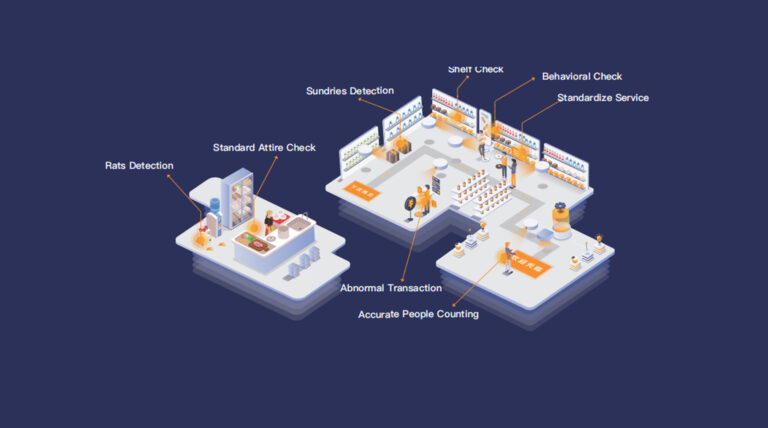
At OVOPARK, our work covers people counting, heatmap and customer behavior analysis alongside other AI-based retail management scenarios. Around 60% of our workforce is dedicated to R&D, with technical work focused on areas including video analysis, embedded intelligent products, and AI.
Privacy and Analytics Can Serve the Same Retail Goal
Privacy-preserving video analytics helps retailers understand customer activity while reducing unnecessary identity-based data collection. By focusing on traffic, dwell time, queues, and store zones, businesses can gain useful operational insights while keeping privacy considerations in the process.
For retail, restaurant, and large chain operations, this approach can turn customer flow, dwell time, queues, and store zones into measurable information. When privacy considerations are built into data collection, processing, access, and reporting, video analytics can remain focused on what store teams actually need—clear information about how their locations operate.